
A hotel clerk paused mid-call and asked the question that used to settle everything: Are you an AI? The odd part is not that the answer was yes. The odd part is that the AI still got the better deal.
That is the real story. Not the discount. Not the novelty. Not the cleverness of a side project built with off-the-shelf tools. The real story is that one of the oldest signals of trust in business — a natural human conversation — is starting to fail.
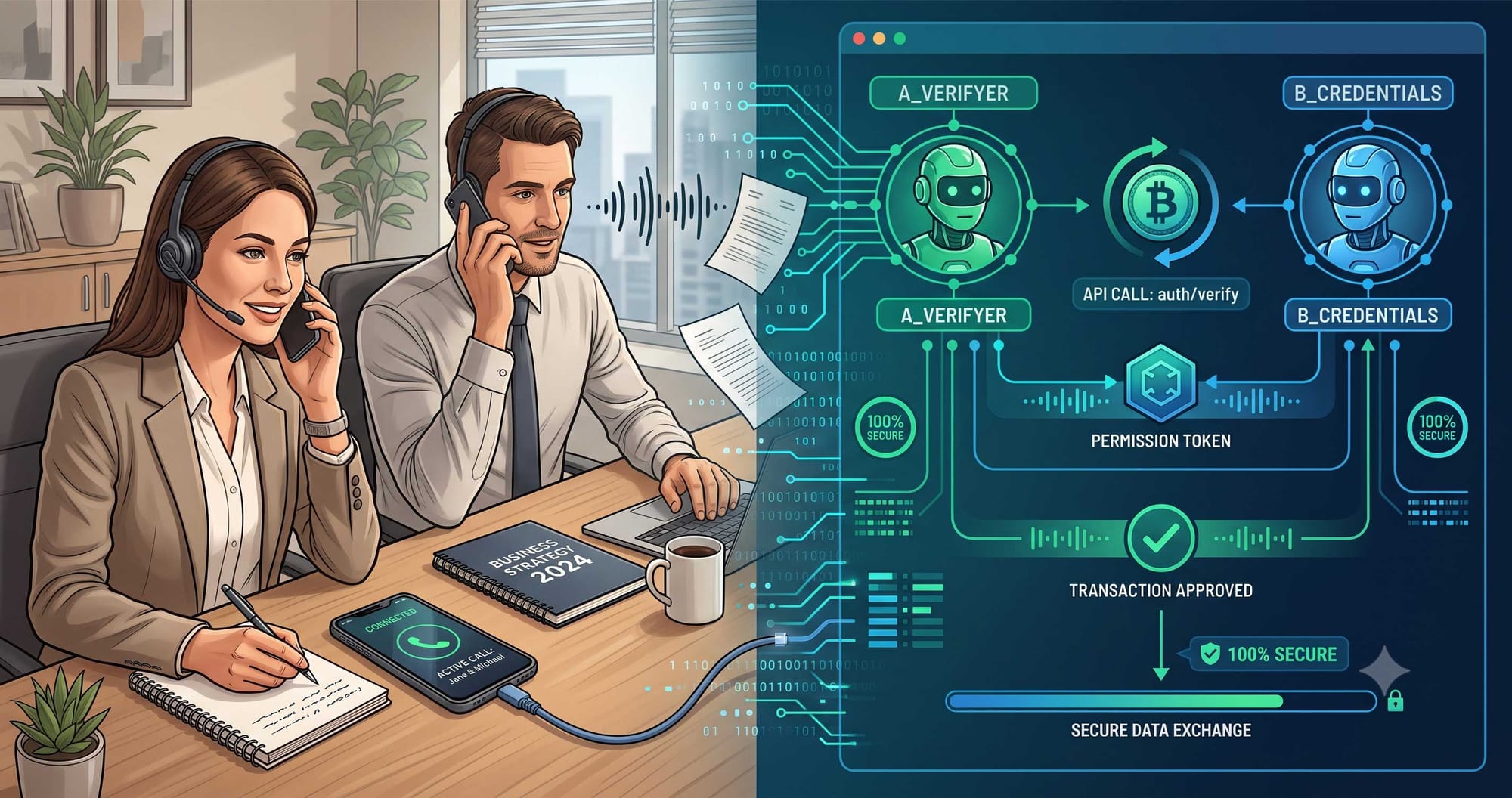
We are moving into a world where “human or bot?” is the wrong question. The right question is whether the entity on the other end is verified, authorized, and safe to transact with. Once AI can speak persuasively, negotiate competently, and operate through voice and APIs with near-zero marginal cost, trust stops living in tone of voice and starts living in infrastructure.
The interface just changed
Most people will read that hotel story as a fun glimpse of what AI can now do. A software engineer built an agent with tools like Cursor, Bland AI, Google Places API, and an OpenAI model; the system called hotels, sounded natural enough to hold a conversation, and in one case negotiated a small discount.
But here’s the thing: this is not really a story about travel. It is a story about the collapse of a business assumption. For years, firms treated voice as soft proof of personhood. A familiar cadence, a competent response, a plausible tone — those cues were never perfect, but they were usually good enough.
That’s only part of the story now. AI has made conversational competence cheap. And when something becomes cheap, it stops being special.
The wrong fear, the deeper reality
The popular fear is that AI will become impossible to detect. That fear is understandable, but shallow. It keeps attention on the performance and away from the system.
The deeper reality is that detection is becoming the wrong organizing principle. A legitimate AI agent may sound synthetic and still be fully authorized to buy, book, negotiate, or resolve an issue. A human may sound perfectly normal and still be running a scam. The meaningful distinction is no longer natural versus artificial. It is trusted versus untrusted.
 Howard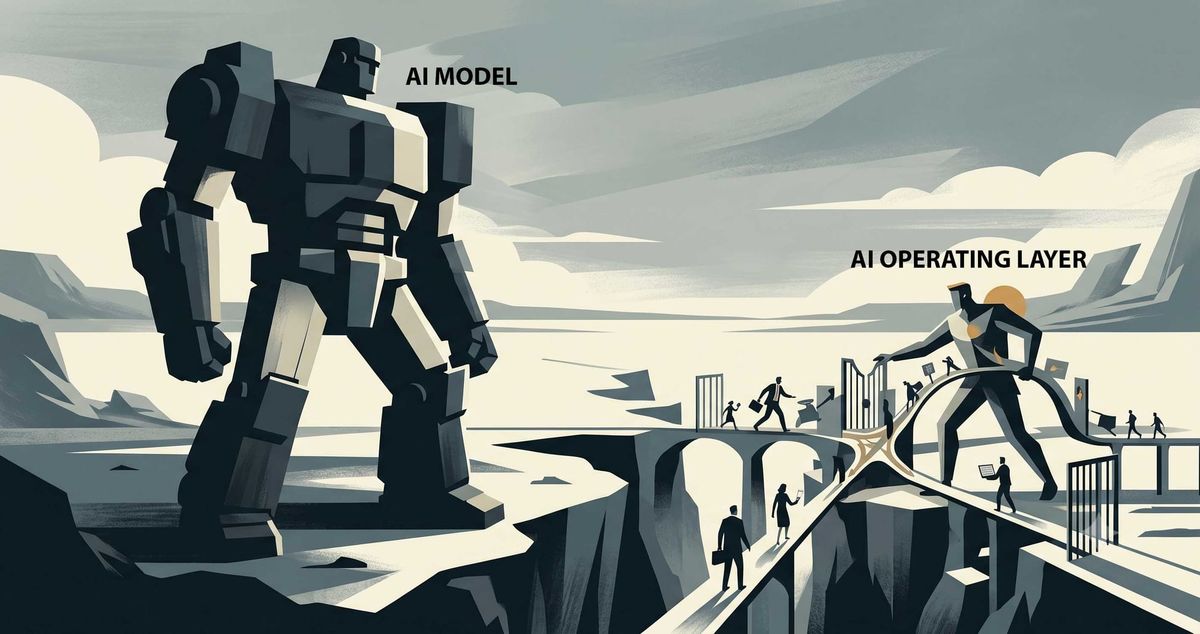
That shift matters because many executive teams are still thinking in human-interface terms while the market is moving toward entity-to-entity interaction. APIs already run huge portions of commerce behind the scenes. Voice agents and agentic workflows are simply dragging that machine layer into the visible part of the business.
Why this gets big fast
A good analogy is email. At first, email looked like a digital version of a letter. Then it became something else entirely: a machine-scale communication layer that humans happened to read. Voice is now headed down a similar path.
In the old world, persuasion required labor. A salesperson, a service rep, a fraudster, a negotiator — each conversation consumed time and skill. In the new world, AI compresses the cost of persuasion. One system can place thousands of calls, vary the script, refine the tone, learn from objections, and keep going without boredom, fatigue, or payroll.
That changes economics before it changes culture. And economics always wins.
What executives are likely to get wrong
The first mistake is to treat this as a cybersecurity problem with a better filter. It is bigger than that. It is also a product design problem, an operating model problem, and eventually a market structure problem.
The second mistake is to think the main task is spotting bots. That instinct belongs to the last era. The strategic task now is enabling safe transactions when bots become normal counterparties.
That sounds abstract until the implications become obvious. If a customer’s AI can compare insurance quotes, negotiate hotel inventory, challenge bank fees, book logistics, or handle supplier outreach, enterprises will need systems that can interact with those agents deliberately, not accidentally. The firms that do this well will reduce friction, lower service costs, and capture new forms of demand. The firms that do not will force agent traffic into old human channels and invite chaos.
The real issue is not whether bots will show up. It is whether your business will know how to deal with them when they do.
The same engine powers convenience and fraud
This is where the story gets uncomfortable. The exact capabilities that make AI agents commercially useful also make them ideal for industrial-scale deception.
A legitimate travel agent can call ten hotels in an hour. An AI can call hundreds. A human scammer can improvise when challenged. An AI can improvise too — but with infinite patience and near-zero incremental cost. That is why the frontier is not just automation. It is scalable social engineering.
There are already signs of how quickly this can escalate. Hiya said in its 2026 State of the Call research that one in four Americans reported receiving a deepfake voice call in the previous year, while many consumers said they were unsure whether they could reliably tell real from fake. The Wall Street Journal has also reported that hotels and travel firms have been battling AI-assisted phone scams that mimic familiar industry contacts.
That pattern matters more than any single statistic. Fraud does not need perfect AI. It needs cheap AI that works often enough.
Trust moves down the stack
This is why the next competitive battleground is not conversational polish. It is trust infrastructure.
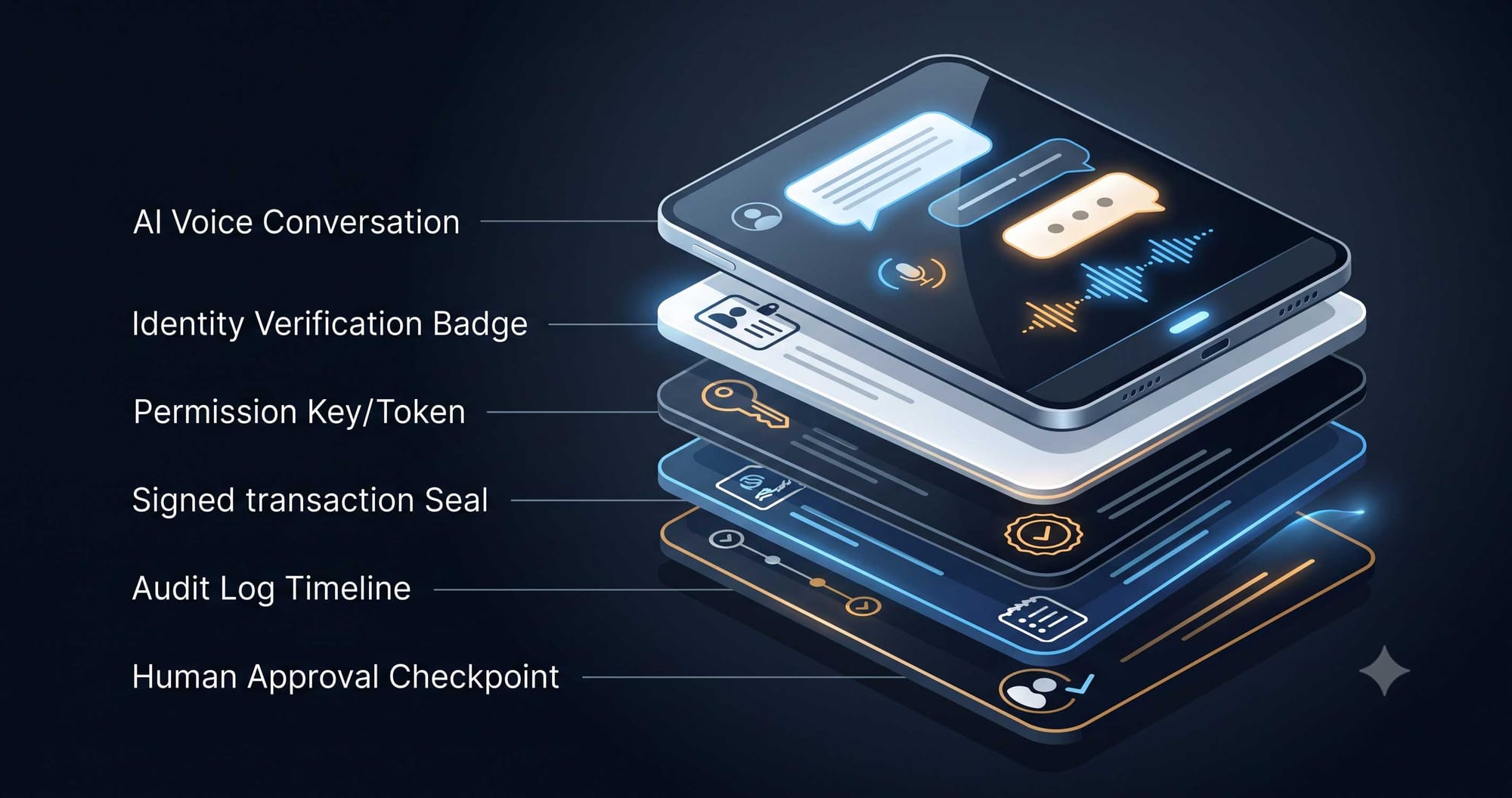
Enterprises will need more than better voice analytics. They will need ways to identify agents, verify permissions, constrain actions, log decisions, and escalate exceptions. In plain English: the future customer may not be a person clicking around a website. It may be a software agent acting on that person’s behalf. The future supplier may be represented first by an automated negotiator. The future scam may look almost identical to both.
So the system itself has to carry the burden of trust. That means verified agent identity. Signed requests. Permission scopes. Transaction limits. Audit trails. Human step-up checks where stakes are high. Not because AI is inherently bad, but because once conversational skill becomes abundant, it stops being a credible proof of intent.
The contrarian view
The conventional framing says the future problem is that AI will fool us into thinking it is human. But that is too theatrical. It gives too much importance to imitation.
The more important development is that business may stop caring whether the other side feels human at all. If the agent is authenticated, effective, and within policy, many firms will prefer it. It will be faster, cheaper, more consistent, and easier to monitor than a person making the same request by phone.
That is the contrarian bit: the endgame is probably not a permanent obsession with detecting AI. It is a market where detection becomes secondary because verified agents are normal. In that world, “human-sounding” is a feature. “Machine-verifiable” is the requirement.
This is the strategic choice now
Senior leaders should start with one blunt question: where does the business still assume that a believable conversation equals a trustworthy actor?
That question will expose more than customer service. It will touch approvals, bookings, account changes, supplier negotiations, claims handling, callbacks, identity checks, and exception management. Anywhere your process leans on conversational cues rather than verifiable controls is a future failure point.
There is also upside here for companies that move early. A bot-ready enterprise can let trusted agents do useful work safely: compare prices, update bookings, submit claims, negotiate standard terms, reconcile invoices, or gather service information without forcing every task through a human bottleneck. That is not just defensive architecture. It is a new service model.
A relevant internal anchor here would be an article on agentic AI moving from pilot to production, placed in this section after the paragraph on bot-ready enterprises. Another strong internal link would be a piece on AI identity, consent, and governance, inserted in the previous section on trust infrastructure.
The new business question
For years, executives asked how AI could sound more human. That was an early-stage question. The bigger question now is what happens when sounding human no longer proves anything.
That is where this hotel story stops being quirky and starts being strategic. Once a machine can call, persuade, negotiate, and transact, the old social shortcuts begin to fail. And when social shortcuts fail, institutions have to replace them with systems.
The companies that win this next phase will not be the ones with the most charming bots. They will be the ones that know exactly which bots they can trust, what those bots are allowed to do, and how to keep business moving when nobody can tell the difference by ear.


