
AI is no longer being won in the lab. It is being won on the desktop.
For a while, the story was simple: better models win. Smarter, faster, cheaper. That story is breaking down. Model quality is still table stakes, but it is no longer where advantage compounds. The battleground is shifting to the operating layer—the place where AI actually shows up in work: your laptop, your inbox, your documents, your workflows, your default interface.
The race has moved up the stack
This shift matters because value follows behavior, not capability. The system that sits between the user and the model shapes what gets used, how often, and for what purpose. It controls attention, context, and ultimately decisions. That is where power accumulates.
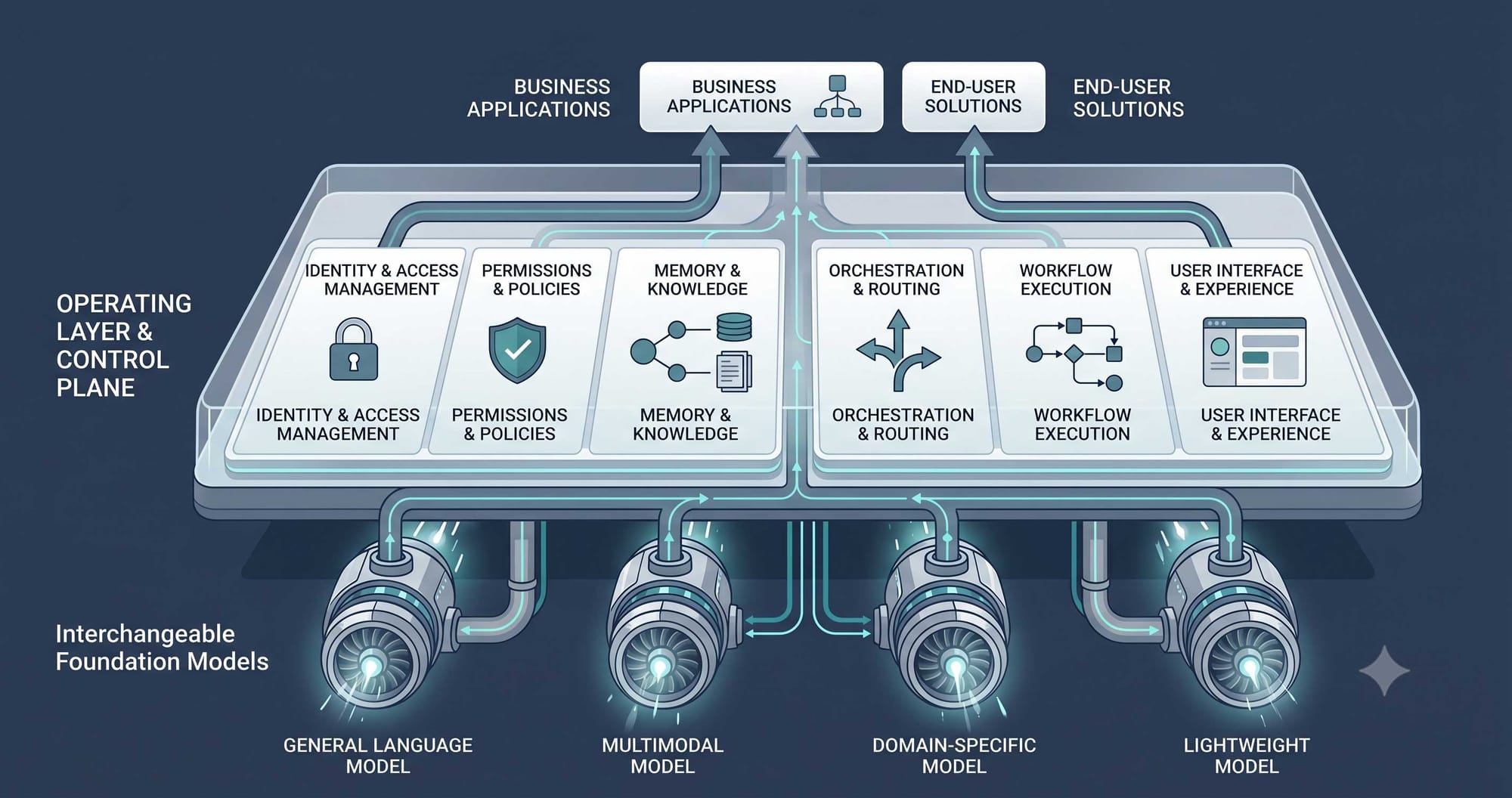
The core thesis is straightforward: as models commoditize, advantage moves up the stack. The winners will be the companies that own the operating layer—distribution, workflow integration, identity, permissions, memory, and execution across tools and devices. Not just intelligence, but control over how intelligence is applied.
 Howard
Why benchmark wins are losing their shine
Most people are still asking the wrong question: “Which model is best?” That question assumes intelligence is the product. In reality, intelligence is becoming an ingredient.
A slightly better model that lives in a browser tab is strategically weaker than a slightly worse model embedded across your operating system, your productivity suite, and your enterprise workflows. One is impressive. The other is indispensable.
The difference is not subtle. It is the difference between asking AI for answers and having AI complete work.
The real moat sits between model and user
Think of two assistants. One gives brilliant advice but cannot access your files, your systems, or your calendar. The other is less eloquent but can read your documents, update your CRM, draft emails in your tone, trigger workflows, and coordinate across tools. In practice, the second assistant wins every time. AI is moving decisively in that direction.
This is the mechanism behind the shift. AI is transitioning from a chat interface to an execution layer. It is becoming ambient, embedded, and persistent. Instead of stepping out of your workflow to “use AI,” AI is being woven into the workflow itself—triggered inside documents, emails, meetings, codebases, and enterprise systems.
 Howard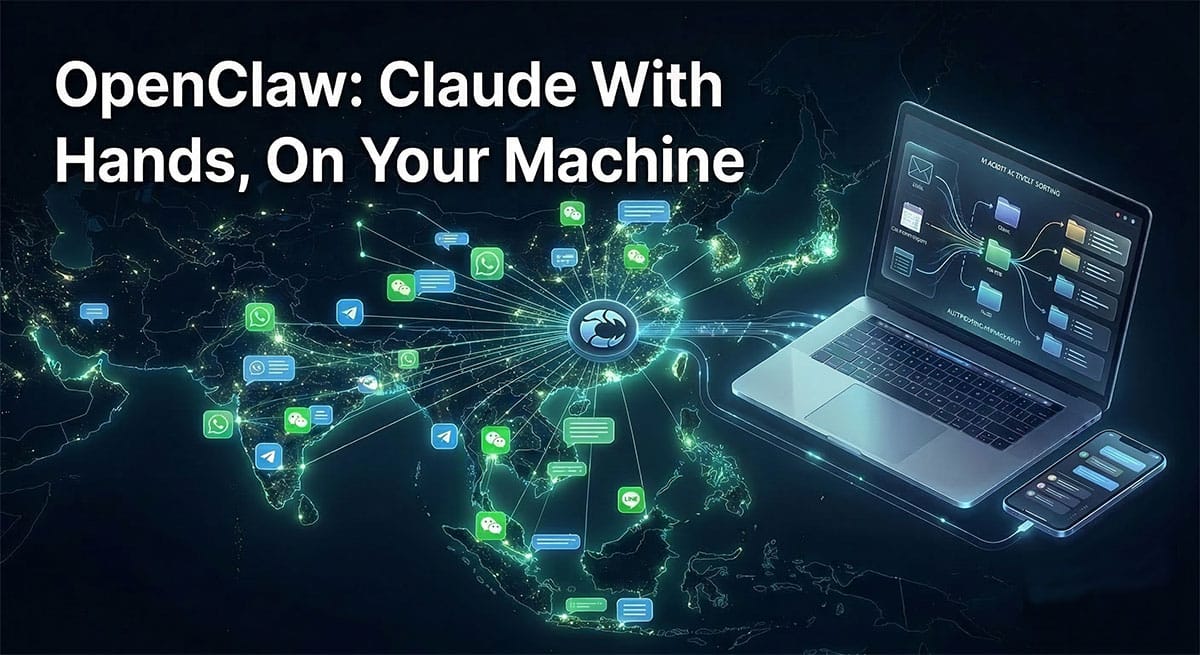
Once that happens, the operating layer becomes the control point. It determines:
- Who the user is: identity.
- What the AI can access: permissions.
- What it remembers: context and memory.
- What it is allowed to do: actions and orchestration.
Control these, and you control not just the experience, but the outcomes. You shape habits. You capture data exhaust. You define switching costs. You decide which models are used, when, and for what.

Where the battle is already visible
This is why the current moves by platform players look the way they do. Microsoft is not just shipping models; it is embedding Copilot across Windows, Office, and enterprise workflows to become the default layer for knowledge work.
The strategic goal is not to win a benchmark. It is to sit in the critical path of daily tasks.
The same pattern is emerging on the consumer side. AI is becoming more personal, more embedded, and increasingly voice-driven. The standalone chatbot is giving way to an always-on assistant that spans devices. The interface is no longer an app; it is a layer. And that layer is where both consumer and enterprise experiences are converging.
Enterprise buyers are already adapting. The conversation has shifted decisively. It is less about raw model performance and more about:
- How does this integrate with existing systems?
- How is data governed and secured?
- Can it operate across applications reliably?
- Can identity, permissions, and auditability be controlled?
 Howard
In other words, can this fit into the operating model—not just the tech stack?
Designing for the layer, not the logo
This is consistent with every major platform shift. The layer closest to user behavior captures the most durable value. Operating systems beat hardware. Browsers reshaped the web. Mobile platforms redefined entire industries. In each case, the control point was not the deepest layer of innovation, but the layer that mediated usage.
AI is following the same path.
There is an important nuance. Models still matter. Breakthroughs in reasoning, multimodal capability, and efficiency will continue to reset the frontier. But their impact is increasingly filtered through the operating layer. A superior model without distribution, integration, and execution is a feature. A well-placed model becomes a platform.
For enterprise leaders, the implication is not to chase the “best” model. It is to design for control and flexibility at the operating layer.
That means building a multi-model, workflow-first architecture, where different models can be orchestrated based on task, cost, and risk. It means investing in identity, permissions, and governance as first-class AI capabilities. It means embedding AI into workflows, not bolting it on as a separate tool. And it means being deliberate about which interfaces—desktop, mobile, voice, embedded assistants—become the default entry points for work.
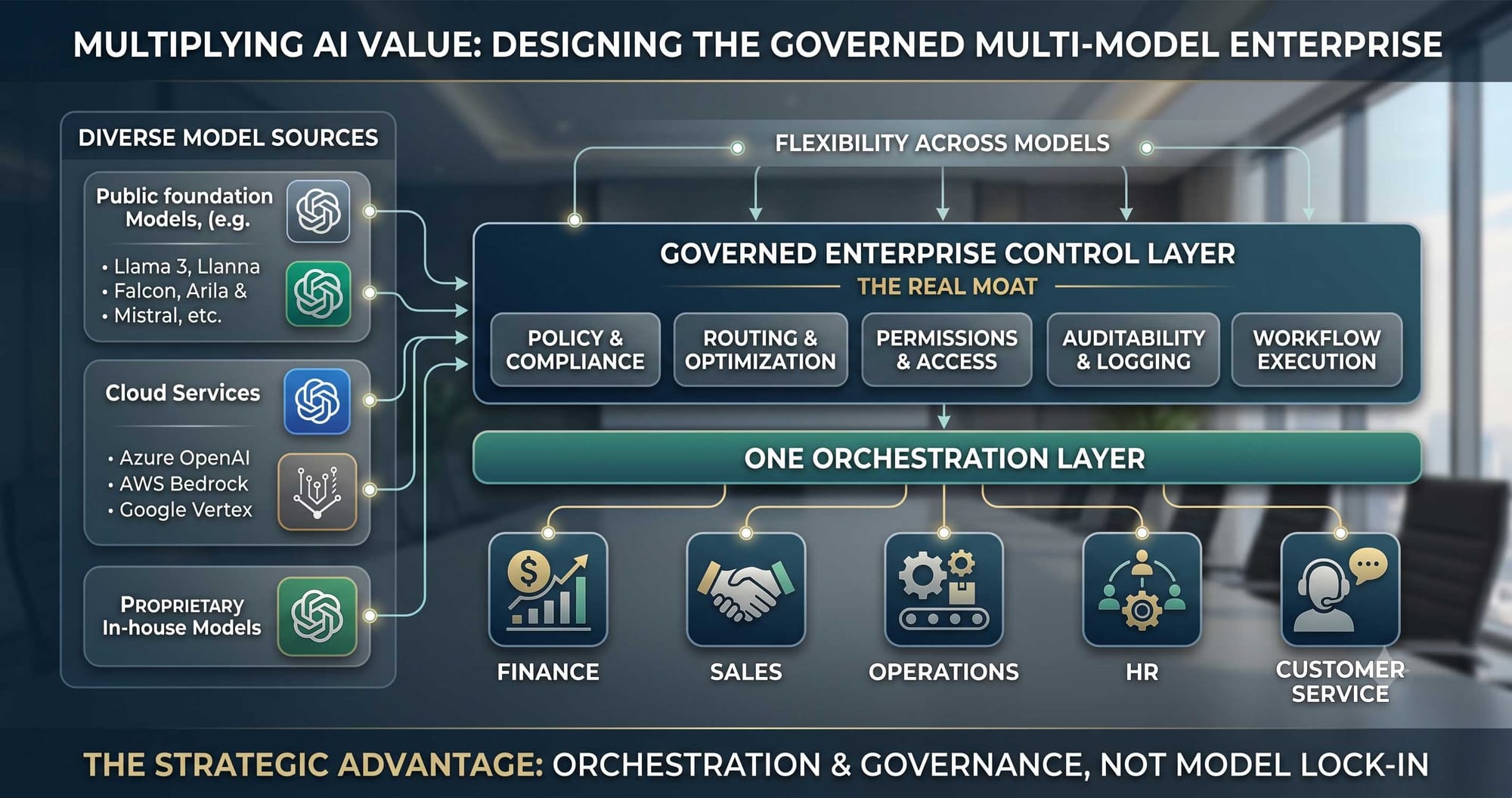
The layer that wins behaviour wins value
The strategic question is no longer “Which model do we standardize on?” It is “Who controls the layer where our work actually happens—and should it be us?”
Because in this phase of the AI cycle, the model is intelligence. The operating layer is power.
